
Not Moscow’s Story: One Komi Activist’s Fight to Reclaim the Arctic
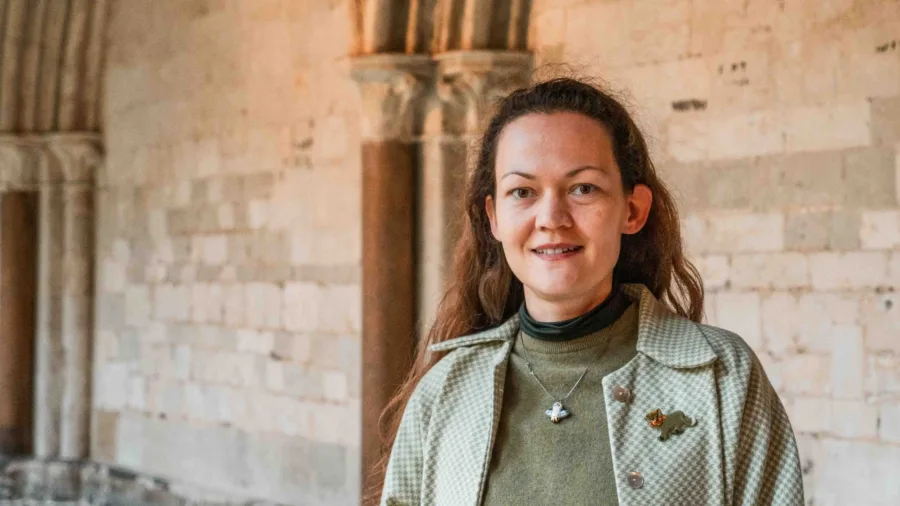
While Moscow is trying to transform the Arctic into a military-economic hub, the indigenous communities who have lived there for centuries are losing ground – literally and politically. Lana Pylaeva, a Komi activist and JST Fellow, is advocating to change this.
Lana is a theoretical chemist who, up until the full-scale invasion of Ukraine, was fully focused on her scientific career. She is originally from the Komi Republic, a territory situated in the Arctic Circle, near to the Ural mountains. She says: “At the beginning of the full-scale invasion, Russia was declaring that it was protecting Russian peace. The main narrative was that Ukrainians are almost like Russians, but not quite.” This is a narrative that is also applied to the Komi, who are not officially recognised as indigenous people under Russian law. Their rights are severely restricted and their representation in the places where political decisions are made is very limited.
It is a narrative that sparked Lana’s transition into civic activism. “I experienced discrimination growing up. And then, of course, when I heard this narrative about Ukrainians in 2022, in this very emotional moment, I supported Ukraine from the start of the full-scale invasion.”
Lana was already living in the Netherlands at this time and the day the war started she went straight to The Hague to protest. “At the beginning, I was doing a lot of humanitarian work supporting people who were fleeing to the Netherlands, arranging doctor visits, helping people meet basic needs, such as getting baby formula,” says Lana. “I was volunteering with an organisation called Free Russia NL, which I set up with a small group of people, including another JST Fellow, Sascha Molokostova. We were also organising protests in Amsterdam to drag the attention to this and to say that we are from Russia, but we are against this war and we support Ukraine.”
Protecting Komi land and culture
In 2024, Lana took on the role of director at Komi Daily, a media project that focuses on news and stories from Komi. “I come from a Komi speaking family, and this part of my identity was always very important and close to my heart,” says Lana. “We have a language which is more similar to Finnish and Estonian than to Russian, and we preserved our language and culture.
“My main aim is to tell the true story about the history and culture of Komi. Because what we learn in schools in Russia is a history written from the Moscow perspective, from the centre of the empire. And then the whole narrative is basically, these were uncivilised people that were very happy to join the great empire.
“We also want to reach an international audience and tell other people all over the world that Russia is way more diverse and different than just Moscow, than a blonde girl in a red dress with a balalaika and that we have different peoples inside Russia. We have our own cultures, our own languages that are not even Slavic.”
The Arctic, climate change and indigenous rights
Lana’s work to amplify indigenous voices – and bring them into conversations about Russia’s future – extends beyond her role at Komi Daily. She also consults for Arctida, an NGO dedicated to investigating and analysing the Russian Arctic across climate change, governance, and indigenous rights.
As a member of the Komi people, she understands the importance of incorporating indigenous knowledge and perspectives into policy discussions and safeguarding land rights, so indigenous people have control over what happens in their territories.
She explains that the Komi Republic is being exploited by Russia – with disastrous consequences: “There are lots of resources being extracted from our territory, and we are left with an ecological catastrophe.” The region was the site of one of the largest oil spills in history in the 1990s, and oil spills are still common today. Existing legislation is inadequate and Komi are not included in political decision-making on their territory.
Lana wants to change this: she is campaigning to hold the Russian government accountable for environmental negligence, to secure formal indigenous recognition, and to guarantee meaningful Komi representation in policy decisions that affect the republic’s land, resources, and future. She says: “Integrating indigenous and regional knowledge is not symbolic; it is essential for developing an accurate, forward-looking Arctic strategy and for any future engagement with a post-imperial Russia.”
Working towards a just peace
Lana was recently selected to join the Platform for Dialogue with Russian Democratic Forces of the Parliamentary Assembly of the Council of Europe (PACE) as a representative of indigenous peoples and national minorities. The platform, established in October 2025, aims to reinforce the capacity of Russian democratic forces to bring about lasting democratic transformation in Russia and help achieve a sustained and just peace in Ukraine.
The PACE platform gives indigenous activists a clear voice, reserving 5 out of 15 places for them. As Russia has effectively left the Arctic Council, Lana’s participation in the platform is a crucial opportunity to bring the concerns of the Komi and other indigenous peoples – and the future of Russia’s Arctic territory – back on the global agenda.
For Lana, this also represents a big step forward in her own work and gives her the chance to advance her goal of including indigenous voices in the discussion about a future Russia, which is a key focus of her JST fellowship.
Building connections through the JST fellowship
Lana’s vision is to one day create a platform to support indigenous researchers from Russia, enabling them to showcase their work and connect to other academics inside Europe and worldwide.
Lana says: “The legislation around indigenous and nature rights in Russia is still very primitive. Rather than starting from scratch, I want to use the JST fellowship to connect with activists and scholars from other regions of the world — to learn from best practices that already exist and use them as a blueprint for what a better future in Russia could look like.
“It is also a great opportunity for Arctida and Komi Daily to provide UK policymakers with verified, region-specific insights into political, social, security, and environmental trends in the Russian North, insight grounded in lived experience and long-standing community relationships.”
Also read about the work of JST Fellow Vadim Vieru, who is advocating for the legal protection of people fleeing Transnistria, a Russian-controlled region of Moldova: