
What can green hydrogen offer in a global energy crisis?
As countries struggle to deal with the economic fall-out from the Iran war, Ukraine and Scotland may hold part of the solution for creating a more resilient energy system.
The US-Israel war on Iran, and the blockade of the Strait of Hormuz, has brought global energy security – and vulnerabilities – into sharp focus. As the flow of oil through the Strait slows to a trickle, the case for fast-tracking alternative energy resources has never been clearer.
Iaroslav Kryl, CEO of Hydrogen Ukraine LLC, argues that although such crises are highly destructive, they can also act as catalysts for change and innovation.
“The events in the Middle East will drive the development of renewable and decentralised energy systems,” he says. “Alongside this, we are likely to see an acceleration of hydrogen-related products. This is no longer only about decarbonisation. It’s about energy independence, food security and ultimately resilience and survival.”
Viacheslav Luchnykov is director of strategy & innovation at UDP Renewables, CEO of UDPR Hydrogen and a co-founder at GreenWest PtX. He says: “The blockade highlights the challenge for global energy architecture in ensuring security of supply, and geography plays a critical role. Both Scotland and Ukraine are located close to major hydrogen demand centers, which provides a competitive advantage.”
Sharing knowledge and expertise
Iaroslav and Viacheslav are part of the latest cohort of JST Fellows who joined our 2026 Ukraine Recovery and Reconstruction Leadership Programme, delivered in partnership with the Scottish Government. The Fellows are leaders in the energy sector and are committed to developing Ukraine’s green hydrogen industry. During the programme they had the opportunity to discuss their work with policymakers, including ScotGov representatives and other regulators.
Scotland is in a strong position to share knowledge and technical expertise. Its universities, research institutes and innovation centres have been developing hydrogen technologies for two decades, aligned with European research frameworks.
Scotland also benefits from an ecosystem of professional networks – engineers, energy specialists, industry consortia, and public sector partners. Working together, they have produced pilot projects, demonstration sites, and cross-border partnerships that place Scotland firmly on the map as a hydrogen innovator.
Benefits of green hydrogen
So, what is green hydrogen? According to Iaroslav: “Hydrogen is currently produced from natural gas, which creates a lot of CO2 emissions. During green hydrogen production, we need only two resources, green electricity and water. Using electrolysis, we split water into hydrogen and oxygen. There are no CO2 emissions.”
While the transition away from fossil fuels has focused on wind and solar, expanding the mix to include green hydrogen has major advantages. It can store surplus renewable power, decarbonise hard-to- electrify sectors and could make use of existing gas pipelines and underground storage facilities. As such, it could act as an energy carrier for wind and solar and fill critical gaps. The process of producing green hydrogen also adds value in the chemical industry, with by-products including green ammonia and fertilisers – vital for food security.
Wind, water and infrastructure
For Ukraine, the push to decarbonise is not only driven by climate considerations. The war has shown that its centralised energy system is highly vulnerable to attack. And the country has used up 70% of its gas reserves, so urgently needs to find alternatives to remain energy independent.
The good news is that Ukraine has both the abundant wind and water resources for renewable energy and green hydrogen production and an industrial infrastructure that could be adapted to transport and store it.
Geologist Sergii Diakonchuk is head of R&D department at Ukrtransgaz, a company that operates Ukraine’s underground gas storage. “We have the biggest gas transmission system in Europe and the biggest capacity of underground gas storage,” he explains. “We are researching the geography – where we can store hydrogen underground and what sites could be used for this. We’re looking at the technical, geological and economical aspects.”
Recovery must start now
All our 2026 Ukrainian Fellows believe it is vital to develop their country’s technical capacity and legal framework for green hydrogen now. Ukraine’s response to the war has shown how creative and innovative its people can be under pressure.
Viacheslav explains: “Since 2022, the main focus has been on resilience – and energy plays a key role in that. Ukraine has strong potential to become a hub for innovation, where new solutions are both tested and implemented. Because of the current challenges, we have to adapt quickly, which is why many technologies are being piloted here. At the same time, we are thinking about the future – what lessons we can learn and pass on to the next generation.
“It’s not just about dealing with today’s challenges, but also about preparing for what comes next. We need to keep developing projects and frameworks now, so that Ukraine is ready for partnerships and investment opportunities as soon as conditions improve, rather than waiting for the war to end.”
European energy security
Although large-scale infrastructure projects cannot be implemented while Ukraine’s energy system is under attack, JST Fellows believe now is the ideal time to build technical skills and knowledge. To attract the high level of investment needed, Ukraine would have to develop a strong domestic demand and internal consumption as a foundation for a sustainable hydrogen economy. It would also need to be ready to produce and distribute green hydrogen energy to foreign markets, including the EU. JST Fellow Ivan Bondarchuk, a lawyer specialising in energy projects and deputy head of the Ukrainian Wind Energy Association, says: “I believe this is one of the fields where Ukraine will be able to play a key role after integration with the EU. We have a chance to lead from the very beginning and to make our contribution not only to national, but to European security.
“The biggest challenge is that nobody yet knows how to integrate hydrogen into an energy system. We already have the first draft law for the development of the hydrogen market in Ukraine. This involves implementation of European legislation, but we need to adjust it to Ukrainian realities. And we really need the first pilot projects to be run, so we can see which regulatory model will be optimal. Then we can adjust our legislation.”
Innovation in Orkney
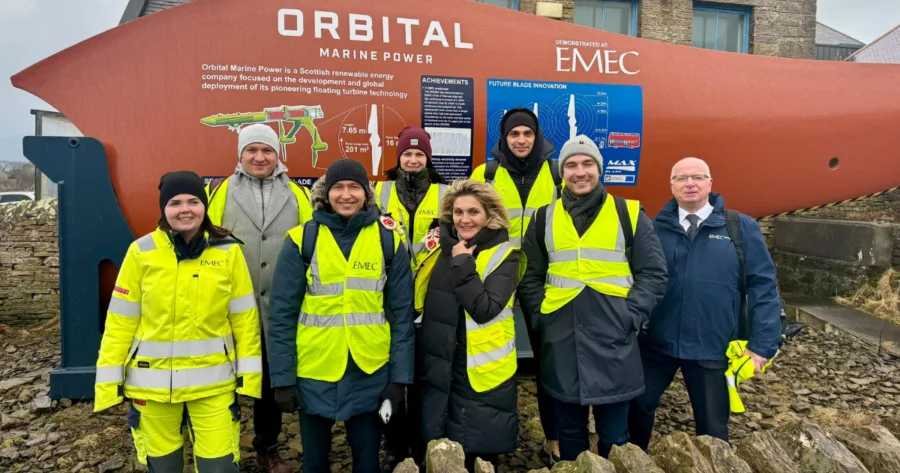
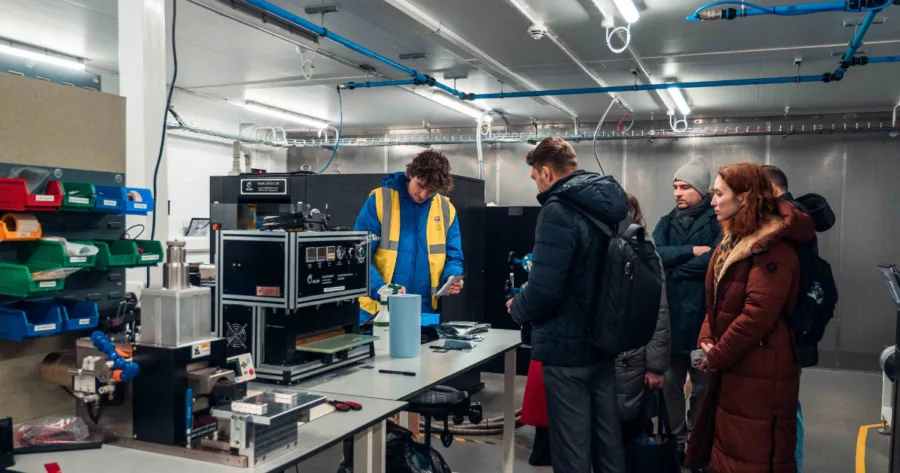
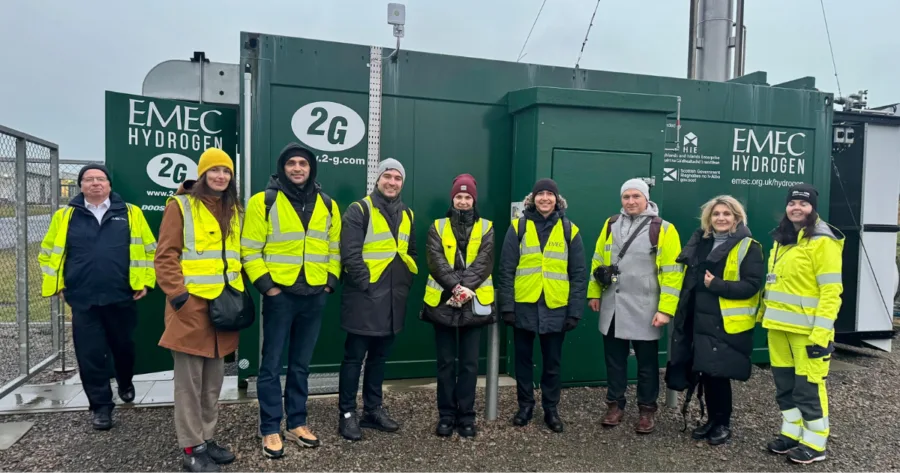
One highlight of our Ukraine Recovery and Reconstruction Leadership Programme was seeing a hydrogen pilot project in action. The Fellows visited the European Marine Energy Centre (EMEC) in Orkney to see its hydrogen R&D facilities.
Iaroslav says: “JST provided opportunities to see how a hydrogen production project can be implemented. When we visited the Orkney Islands, I saw exactly how we can move forward, breaking it down into the smallest phases of implementation, like they did. They showcase how to use hydrogen in a real world, for instance by heating an airport terminal. It’s an innovative project, and the first in the UK.”
Ivan adds: “At EMEC facility, they showed us the technologies we read about but had never seen. It was really inspiring to see how this is tested and to understand how somebody is already doing this.”
Developing human capital
Another part of the puzzle is making sure Ukraine has the skilled workforce needed to run its emerging green hydrogen industry.
Klavdiia Yatsyshyna is an energy advisor on GIZ’s H2-diplo project, which supports Ukraine’s green reconstruction by exploring green hydrogen’s role in decarbonisation providing strategic advice. She also works in the education sector and is an expert in ESG (environmental and social governance).
“During the JST programme, I’m focusing on human capital,” she says. “We need professionals with the skills to develop and implement hydrogen technologies. We have lots of specialists from gas and oil companies. I’m trying to answer questions like: how long does it take to upskill existing specialists? How many specialists in this sphere do we need? Maybe there can be a technology or experience exchange with partners, such as Scotland. If so, how can it be implemented?”
And concrete steps are already being taken to build this talent pipeline. Iaroslav contributed to the National Technical University of Ukraine’s launch of the first interdisciplinary bachelor’s programme in hydrogen and biotechnologies in Ukraine in September 2025. The programme enrolled its first cohort of 10 students, and work is underway to develop a corresponding master’s programme, further strengthening the country’s long-term human capital base in this field.
Making connections
For the Fellows, the JST programme was not only an opportunity to gain technical knowledge but also a chance to exchange ideas and make connections. During the programme Ukrainian Fellows joined leadership sessions with Fellows from our Wider Europe and Central Asia Programme.
“When discussing the future and innovation, it is essential to understand the context of different regions. This helps to connect the pieces of a larger puzzle and develop a broader perspective, including a more practical understanding of the geopolitical landscape,” says Viacheslav. “The opportunity to engage with colleagues from the Central Asian region significantly deepened my understanding from a practical point of view.”
Iaroslav adds: “The most important thing is connection with the people. JST provides that opportunity. I met different people from different countries and all of them have their own vision and insights. They can inspire you to do something new and give you new ideas. We can even establish new connections between countries.”
Read more about our Ukraine Recovery & Reconstruction Leadership Programme.